Faster Embedded Design Starts with Compact Computing
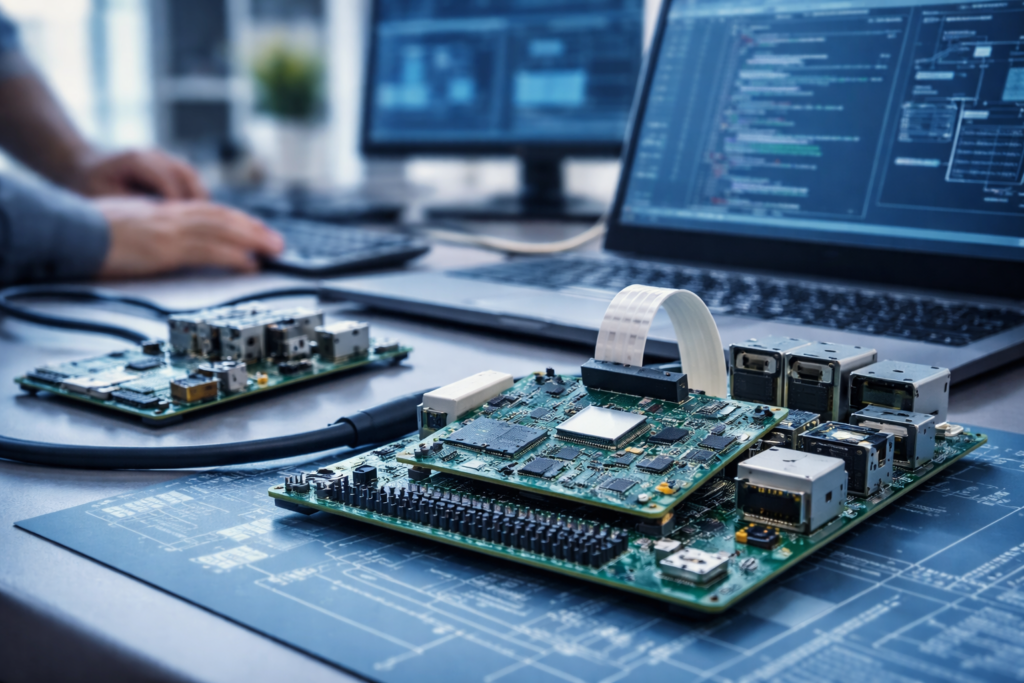
Engineers constantly battle long development timelines in embedded projects. Traditional hardware design often forces teams to wait weeks before they can validate software. However, modern single-board computers (SBCs) and compute modules transform this process. They combine processing, memory, networking, and input/output into a single platform. As a result, developers can shift from concept to prototype within days instead of months.
Moreover, integrated platforms reduce setup complexity while giving teams the flexibility to experiment early. Consequently, companies shorten deployment cycles and bring products to market faster.
Why Integrated Platforms Remove Bottlenecks
Custom board development typically demands extended planning, layout work, and fabrication. Meanwhile, software engineers often sit idle until hardware validation finishes. Therefore, delays stack up and slow innovation. At the same time, embedded applications increasingly require higher computing power than many microcontroller-based designs provide.
SBCs and compute modules solve this challenge directly. They allow engineers to start development immediately without waiting for custom hardware. Additionally, teams can test functionality earlier, adjust designs faster, and avoid costly late-stage changes. In turn, development pipelines flow more smoothly and predictably.
Bridging Development and Production with Compute Modules
Unlike standalone boards, compute modules separate the processing engine from the carrier board. Because of this, developers can begin software work using a standard development kit while hardware designers finalize a custom carrier.
Later, engineers often place the same module into the final product. This continuity minimizes rework and protects software investments. Furthermore, most modules run Linux, which provides access to mature drivers and robust tools. Although this approach limits some low-level hardware customization, it usually delivers a clearer and faster path to production readiness.
Growing Demand Across Embedded Applications
Compact computing platforms now power a wide range of solutions. For example, manufacturers deploy them in industrial automation, human-machine interfaces, digital signage, and edge computing. As industries adopt smarter systems, they also demand quicker iteration cycles.
Since SBCs support rapid testing and refinement, development teams can adapt designs quickly. Consequently, organizations reduce redesign loops and improve deployment confidence.
Spotlight on a Modern Development Platform
The Raspberry Pi SC1754 Compute Module 5 development kit offers a complete environment for evaluating embedded designs. It pairs a compact compute module with a carrier board that exposes critical interfaces and peripherals. Therefore, engineers can prototype efficiently without assembling hardware from scratch.
Linux compatibility enables software creation and validation early in the process. In addition, scalable performance makes the kit suitable for industrial controllers, embedded gateways, and edge computing devices. Ultimately, it provides a structured pathway from experimentation to production hardware.
Key Takeaway
Compact single-board computers and compute modules reshape embedded development by allowing earlier decisions and faster validation. By supporting rapid software testing and scalable hardware strategies, platforms such as the Raspberry Pi Compute Module 5 help teams reduce risk and accelerate product launches. As technology demands continue to rise, integrated computing solutions will remain essential tools in the engineer’s toolkit.
Sources
https://www.ignitec.com/insights/building-an-mvp-heres-why-you-need-a-custom-hardware-prototype/
https://www.linuxjournal.com/content/how-linux-shapes-modern-cloud-computing
https://www.ezurio.com/resources/blog/the-top-trends-in-embedded-development-for-2025-beyond